
The seven strategies
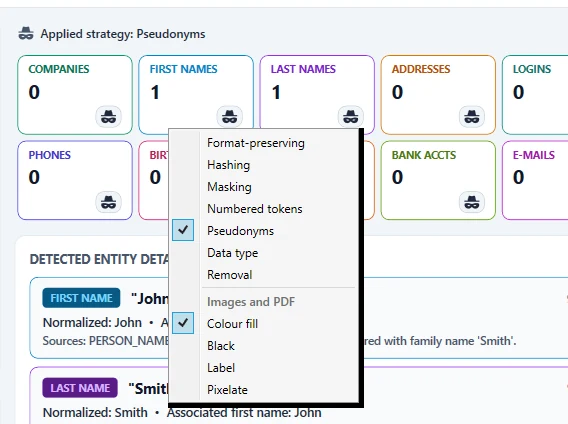
| Numbered tokens | each value becomes a token ([[LAST_NAME_1]]); the same value keeps the same token |
| Masking | characters masked, keeping a hint of the shape |
| Data type | the value is replaced by its category |
| Removal | the value disappears from the text |
| Hashing | a stable fingerprint, computed with the app's key |
| Pseudonyms | a believable identity, always the same for the same person |
| Format-preserving | a value of the same shape: an IBAN stays a valid IBAN, a phone number a phone number |
Tip. Hashing, pseudonyms and format-preserving depend on this app's secret key: the same text always gives the same result, and nobody can recover the value without that key.
One strategy per category
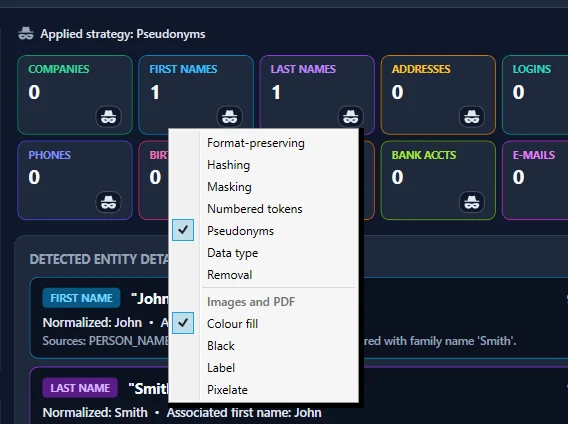
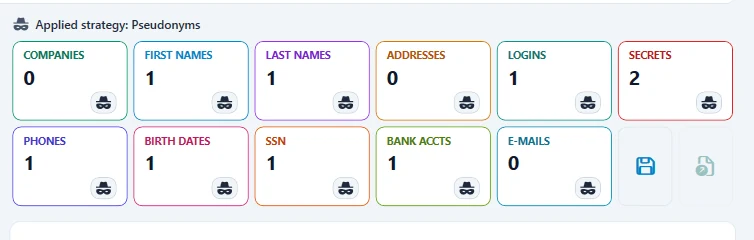
Each counter has a button: it turns the category on or off and picks its strategy. For example: pseudonyms for people, format-preserving for IBANs, removal for secrets.
The same menu also picks how the category is masked in images and PDFs (Images and PDF: fill, label, pixelate, black).
Save a profile
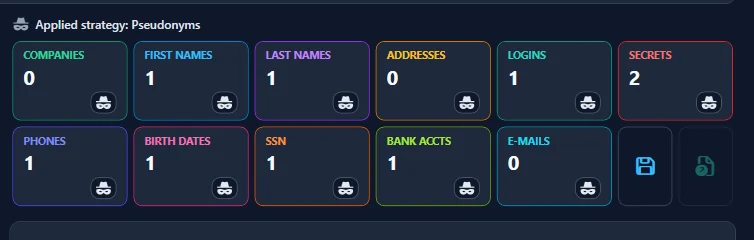
The floppy-disk button saves the current settings under a name; the button next to it loads a profile. In Settings → Saved global strategies, rename, delete or set the default profile, applied at startup.
In Codex and Claude Code
Your profiles apply to what you pseudonymize in the app. The Codex and Claude Code agent keeps its own strategy.
Codex
- The agent replaces values with numbered tokens: masking or data type would give identical replacements for different values, impossible to restore.
- Images sent are masked with a colour fill.
Claude Code
- Same strategy for Claude Code: numbered tokens, restored in the answer.
- The same name keeps its token for the whole conversation, so the model can reason about it.